What does the documentary method consist of?
Sofia Budakova begins each of her works with research. She works with archival documents, museum collections, and private holdings. Authentic objects and historical sources form the foundation of every piece.
Step by step, the composition is built on factual material, where painting becomes a way of visually recording the researched content.
The artist does not act as an interpreter, but rather as a mediator between the source and the viewer.
Documentary Research for the Painting Three Pearls
Historical Context:
The work reflects the early 1960s and the figure of John F. Kennedy (1917–1963), the 35th President of the United States — a symbol of postwar optimism, renewal, and faith in a democratic future. His presidency is associated with a period of hope, cultural growth, and a sense of America’s moral leadership in the world.
The assassination of Kennedy on November 22, 1963 became a turning point for the United States and the Western world, marking the end of the “golden age” of illusions and the loss of a sense of security. Three Pearls captures this historical rupture — the moment when a private tragedy became a collective one, reshaping public consciousness and signaling the transition to a more anxious and contradictory era of the twentieth century.
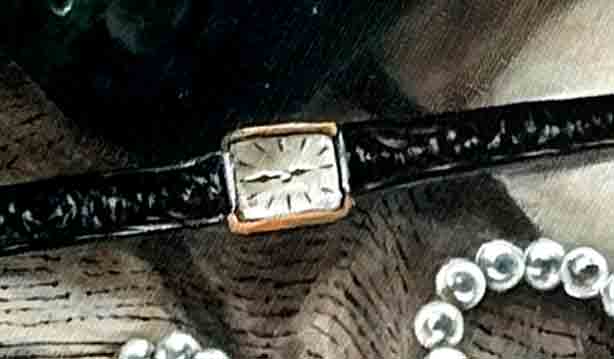
ARTIFACT DOSSIER
Type: Personal wristwatch of the U.S. President.
Origin: A gift from Grant Stockdale.
Features: Caseback engraving: “President of the United States John F. Kennedy / From His Friend Grant”.
Location: Omega Museum (Biel, Switzerland).
Sources: Omega Museum Archive / Guernsey’s Auction Report.
Description & Context: This ultra-thin gold watch was gifted to John F. Kennedy by his close friend and associate, Grant Stockdale, shortly before the 1961 inauguration. In the painting, the hands are frozen at 12:30 — the exact time of the shots fired in Dallas.
Purpose of Inclusion: A direct symbol of «frozen time.» The watch transforms a historical date from a mere statistic into a deeply personal, physically tangible moment of tragedy.
Archival reference Source: Omega Museum, Biel © Omega SA Used for research documentation only.
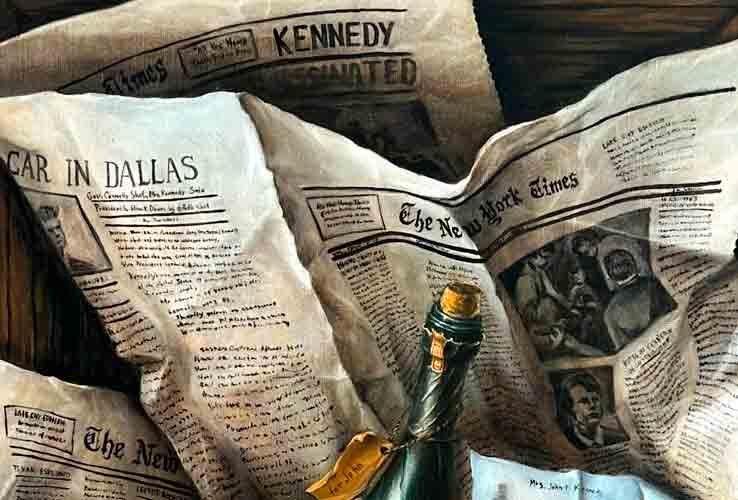
ARTIFACT DOSSIER
Type: Primary printed source (front page).
Origin: USA, New York.
Headline: “Kennedy Assassinated” / “Car in Dallas”.
Location: The New York Times Archives.
Sources: JFK Presidential Library / NYT Digital Archive.
Description & Context: The edition published the morning after the tragedy. It captures the global shock and serves as documentary evidence of the chaos during the first hours following the event.
Purpose of Inclusion: A «chronicle object.» The newspaper provides the compositional framework, creating a documentary backdrop for personal items and emphasizing the public scale of the loss.

ARTIFACT DOSSIER
Type: Literary and political legacy.
Author: John F. Kennedy.
Edition: 1956 Senatorial Edition (Pulitzer Prize winner).
Location: JFK Library and Museum.
Sources: Pulitzer Prize Archives / John F. Kennedy Presidential Library.
Description & Context: A book on political courage written by Kennedy during his time in the Senate. It reveals the President’s intellectual profile and the ideals that the «Golden Age» society believed in.
Purpose of Inclusion: A symbol of legacy. The book connects the President’s persona with his ideas, which survived him. The pink ribbon bookmark inside serves as a visual bridge to Jacqueline’s image.

ARTIFACT DOSSIER
Type: Historical garment (Chanel style).
Origin: Personal wardrobe of the U.S. First Lady.
Status: Symbol of tragedy (represented as a fragment).
Location: U.S. National Archives (sealed until 2103).
Sources: National Archives and Records Administration (NARA).
Description & Context: The pink wool suit worn by Jacqueline Kennedy at the time of the assassination. She famously refused to change out of it, stating: “Let them see what they’ve done.”
Purpose of Inclusion: In the composition, the suit is represented by a pink cloth fragment used as a bookmark. It is the most emotionally resonant marker of the personal drama and the silent courage of the woman.
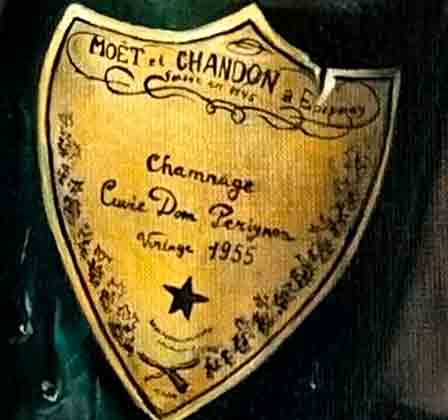
ARTIFACT DOSSIER
Type: Vintage French Champagne.
Origin: Epernay, France (House of Moët & Chandon).
Specific Detail: Shadow of the «woman in pink» reflected in the bottle.
Location: Private collections / Winery Archives.
Sources: White House Hospitality Records / Tastingbook Archives.
Description & Context: This specific vintage was a favorite in the White House during the Kennedy administration. The opened bottle symbolizes an interrupted celebration and unfulfilled hopes.
Purpose of Inclusion: A «vessel of time.» Jacqueline’s reflection in the glass creates a ghostly presence, turning an everyday object into a mystical mirror of history.

ARTIFACT DOSSIER
Type: Philatelic document (“First Day of Issue”).
Origin: U.S. Post Office (Washington D.C. postmark, October 1963).
Symbol: Suspended communication.
Location: U.S. Philatelic Archives.
Sources: Smithsonian National Postal Museum.
Description & Context: An envelope with a stamp issued shortly before the President’s death. It represents letters left unwritten and conversations cut short.
Purpose of Inclusion: The letter as a «vessel of memory» and the stamp as a time marker. It signifies the intimate, human connection amidst global upheaval.
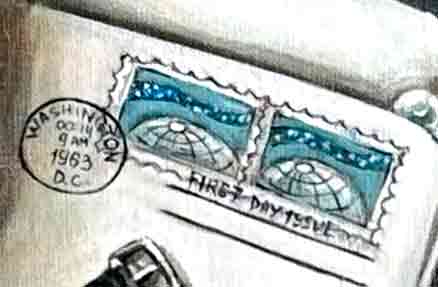
ARTIFACT DOSSIER
Type: Philatelic document (“First Day of Issue”).
Origin: U.S. Post Office (Washington D.C. postmark, October 1963).
Symbol: Suspended communication.
Location: U.S. Philatelic Archives.
Sources: Smithsonian National Postal Museum.
Description & Context: An envelope with a stamp issued shortly before the President’s death. It represents letters left unwritten and conversations cut short.
Purpose of Inclusion: The letter as a «vessel of memory» and the stamp as a time marker. It signifies the intimate, human connection amidst global upheaval.

ARTIFACT DOSSIER
Type: Material metaphor of a forensic fact
Origin: The Warren Commission Investigation.
Specific Detail: Official count of three shots fired (three cartridge casings found).
Location: U.S. National Archives (NARA), College Park, MD.
Sources: Warren Commission Report (1964) / National Archives (Archives.gov).
Description & Context: In the painting «Three Pearls,» the number three is visually linked to the official investigative conclusion—the three shots recorded in the Warren Commission Report. This specific quantity is a deliberate reference to the ballistic structure of the event.
Purpose of Inclusion: In this work, the number three transforms a technical detail into a symbol of historical turning points. By representing the three fateful shots as three separate pearls, the artist elevates a cold forensic fact into a powerful artistic metaphor. These three pearls signify the three fatal strikes that forever influenced the world, serving as a visual testament to the moments that altered the course of history.